
Fire Performs. Bread Waits.
Fire performs. You throw meat on it, it changes in front of you, and you eat. The transformation takes minutes, the reward is immediate, and the uncertainty tolerated is low. Wine performs too. A grape collapses into foam and alcohol; you can see it, smell it, and watch it transform. Fire and wine are honest in that way.
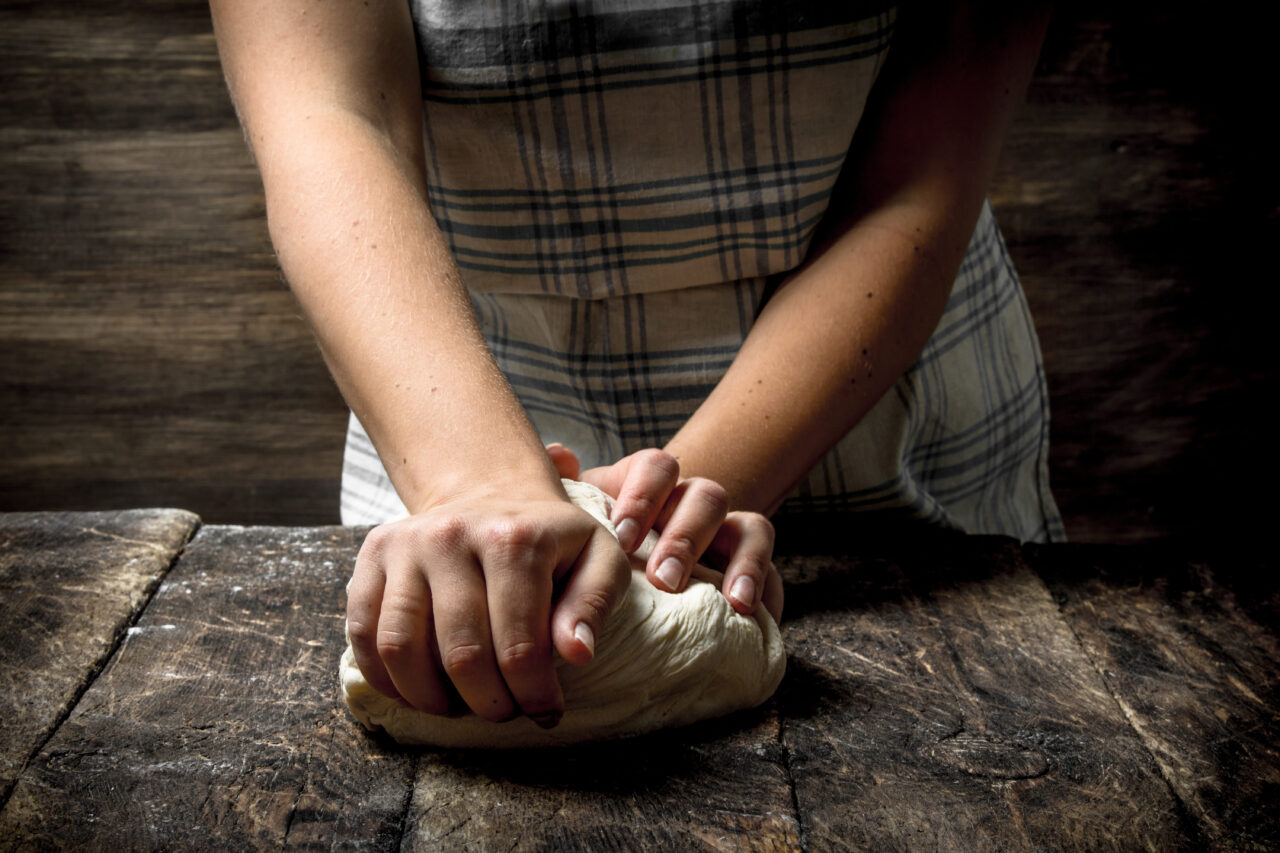
Bread is not. Bread looks inert. Beige. Almost forgettable. It does not sparkle or hiss. It sits there quietly and asks you to believe that something essential is happening out of sight. Nothing about it is dramatic. Everything about it is delayed. That delay is the point.
Fire taught humans that heat could change the world in minutes. Bread taught them that waiting could change the world over seasons. One is spectacle. The other is civilization.
The First Act of Faith
Grain does not advertise its potential. To turn it into bread requires restraint at scale. Someone must harvest thousands of stalks, thresh and winnow them, store them for months without rot or theft, grind them into flour, mix that flour with water, and then wait for fermentation to unfold on its own schedule.
The earliest cereal domestication dates to roughly 10,000–12,000 years ago¹. Residue in stone troughs at Göbekli Tepe suggests fermented grain beverages 10,000–11,000 years ago².
• Earliest cereal domestication: ~10,000–12,000 years ago¹
• Evidence of fermented grain beverages at Göbekli Tepe: ~10,000–11,000 years ago²
At Göbekli Tepe, before pottery and before cities, humans carved monumental enclosures and brewed grain in limestone vats². Someone hauled grain uphill and chose not to eat it immediately. That choice required a new psychological capacity.
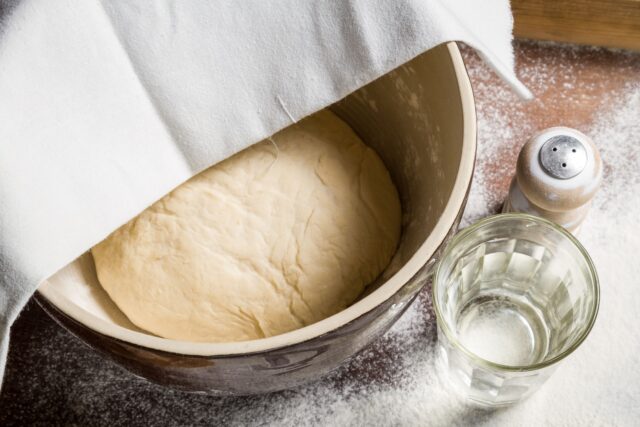
You cannot see yeast metabolizing sugars. You cannot see gluten forming structure. You cannot see starch breaking down into fermentable molecules. You have to believe that invisible transformation is occurring and will continue to occur if left undisturbed.
Fire requires attention. Fermentation requires restraint.
Delayed Gratification Becomes Culture
By the time humans made bread and beer reliably, they had institutionalized delayed gratification. They coordinated calendars, stored surplus, and planned beyond tonight’s hunger.
Research on delayed gratification, including the marshmallow experiments by Walter Mischel (psychologist who studied impulse control in children), showed that children who tolerated waiting tended to demonstrate stronger executive function later in life³.
• Delayed gratification in childhood predicts later impulse control³
• Executive function correlates with long-term planning capacity³
Fermentation is frontal lobe training disguised as food. Impatience is limbic; sourdough is cortical. If you keep opening the oven because waiting makes you nervous, the loaf collapses.
Michael Pollan (journalist who writes about food as culture rather than lifestyle decoration) observes that cooking “connects us to processes that unfold slowly”⁴. Slow processes expose anxiety instead of soothing it. Maria Bamford (comedian who has been admirably transparent about anxiety and OCD) once joked, “My anxiety has anxiety”⁵. Fermentation is exposure therapy for that sentence. You either tolerate the uncertainty long enough for structure to form, or you destabilize it prematurely.
Waiting becomes practice. Practice becomes culture.
Agreement on the Unseen
The leap from flame to fermentation is not culinary. It is cognitive.
Sam Harris (neuroscientist turned philosopher who writes about cooperation and shared reality) argues that “a shared reality is the basis of cooperation”⁶. You cannot see yeast, yet you agree it exists and will behave predictably under certain conditions. You cannot see institutional trust either, yet you agree that it matters. That agreement is civilization.
Bread may have been the first large-scale rehearsal of belief in an invisible but reliable process. Once humans trusted fermentation, trusting accounting, contracts, and institutions required fewer neurological contortions. Waiting trained belief. Belief scaled coordination.
Structure Makes Freedom Possible
Improvisation looks chaotic from the outside, but it rests on shared rules. Jerry Garcia (lead guitarist of the Grateful Dead and accidental theorist of collective rhythm) once said, “You don’t want to be the best at what you do. You want to be the only one who does what you do”⁷. That freedom rested on structure—shared keys, shared tempo, shared expectations.
Auguste Escoffier (the French chef who systematized modern kitchens) wrote, “Above all, keep it simple”⁸. Simplicity stabilizes systems. Julia Child (who taught Americans to cook without losing their composure) said, “No one is born a great cook, one learns by doing”⁹. Repetition builds competence. Competence reduces anxiety. Anxiety destabilizes systems.
Grain changed the mind because it required rehearsal: plant, wait, harvest, store, repeat. Civilization is repetition tolerated long enough to become invisible.
Grain Makes Humans Legible
Forager band size averaged roughly 25–50 individuals¹⁰. Agricultural settlements expanded into the hundreds and thousands¹¹. Cereal crops are storable, divisible, countable.
• Typical forager band size: ~25–50 individuals¹⁰
• Agricultural settlements: hundreds to thousands¹¹
James C. Scott (political scientist who studies early state formation) argues in Against the Grain that cereal agriculture made populations “legible” to emerging states¹². Grain can be counted. Counted grain can be taxed. Taxed grain requires administration. Administration produces hierarchy.
Beer softens hierarchy. Bread sustains it. But the revolution begins earlier. It begins when humans decide not to consume everything today. Impulse suppression is not romantic. It is structural. Waiting becomes governance.

Fragility Is Always Near
Bread must be remade daily. Trust must be renewed daily.
Nancy Silverton (baker who built La Brea Bakery into a sourdough institution) writes, “Bread is alive. It needs to be fed”¹³. So does trust.
• Trust in U.S. federal government: ~20%¹⁴
• Calories from ultra-processed foods in U.S. diet: ~57–60%¹⁵
• Average adult screen time per day: 7+ hours¹⁶
• Adults reporting frequent loneliness: ~1 in 2¹⁷
We compressed time. We outsourced fermentation. We engineered away shared waiting. Fire forced stillness; fermentation forced patience. Acceleration rewards impatience, and impatience destabilizes slow systems.
You cannot sustain democratic norms on chronically dysregulated nervous systems trained for instant reward. That is not metaphor. That is regulation.
What Bread Actually Did
Bread trained humans to wait months for harvest, to store surplus, to coordinate labor, to protect shared resources, and to trust invisible biological processes. It trained executive control at scale. It trained belief in unseen systems.
We learned patience from fermentation. Then we optimized for speed. Then we labeled the agitation “modern life.” Then we treated the symptoms instead of the training deficit. Waiting became civilization. Impatience became profit.
This is Part II of a four-part series on how food reorganized civilization. Part I was fire. Part III is surplus, when stored grain becomes counted grain and counted grain becomes power. Once grain accumulates, someone counts it. Once someone counts it, someone controls it. Once someone controls it, anxiety stops being private and becomes structural.
If this unsettled you, good. Leave a comment. I read them. If you are in Boulder, stop by. I do not have a communal oven, but I do have cookies. And if we cannot sit across from one another long enough to let bread rise or institutions stabilize without tearing them open to relieve our discomfort, we are not simply impatient.
We are untrained.
Footnotes
- Bellwood, Peter. First Farmers: The Origins of Agricultural Societies. Blackwell Publishing, 2005, pp. 23–45.
- Dietrich, Oliver et al. “The role of cult and feasting in the emergence of Neolithic communities: New evidence from Göbekli Tepe, south-eastern Turkey.” Antiquity, Vol. 86, No. 333, 2012, pp. 674–695.
- Mischel, Walter, Shoda, Yuichi, and Rodriguez, Monica L. “Delay of gratification in children.” Science, Vol. 244, No. 4907, 1989, pp. 933–938.
- Pollan, Michael. Cooked: A Natural History of Transformation. Penguin Press, 2013, p. 409.
- Bamford, Maria. Ask Me About My New God! Comedy Central Records, 2013.
- Harris, Sam. The Moral Landscape. Free Press, 2010, p. 57.
- Garcia, Jerry. Interview in Rolling Stone, Issue 723, 1995.
- Escoffier, Aug uste. Le Guide Culinaire. 1903 edition, p. 5.
- Child, Julia. My Life in France. Alfred A. Knopf, 2006, p. 84.
- Kelly, Robert L. The Foraging Spectrum. Smithsonian Institution Press, 1995, pp. 102–108.
- Childe, V. Gordon. Man Makes Himself. Watts & Co., 1936, pp. 87–102.
- Scott, James C. Against the Grain: A Deep History of the Earliest States. Yale University Press, 2017, pp. 121–145.
- Silverton, Nancy. Breads from the La Brea Bakery. Villard Books, 1996, p. 12.
- Gallup. “Trust in Government.” Gallup Poll Social Series, 2023 report.
- Monteiro, Carlos A. et al. “Ultra-processed foods: what they are and how to identify them.” Public Health Nutrition, Vol. 22, No. 5, 2019, pp. 936–941.
- Nielsen. Total Audience Report, 2022 edition, pp. 14–18.
- U.S. Department of Health and Human Services. Our Epidemic of Loneliness and Isolation. Surgeon General Advisory, 2023, p. 7.