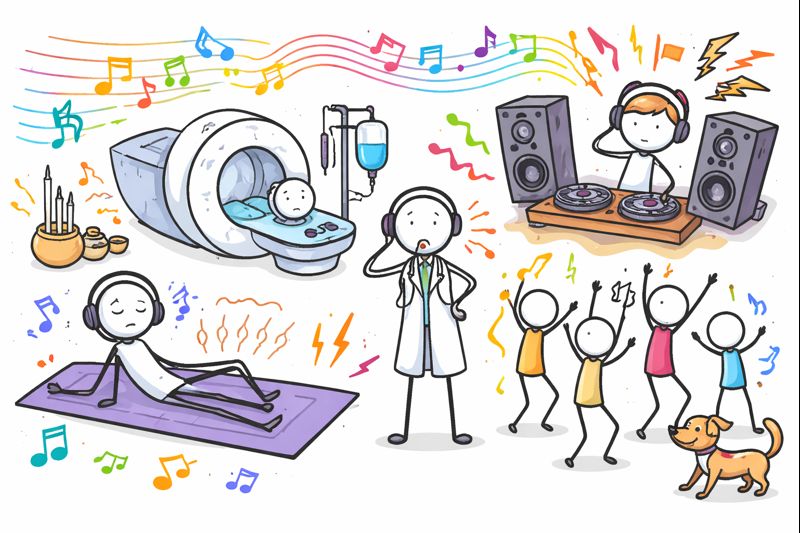
This piece explores psychiatry, science, and lived experience. It is not medical advice, and it cannot replace care tailored to an individual person.
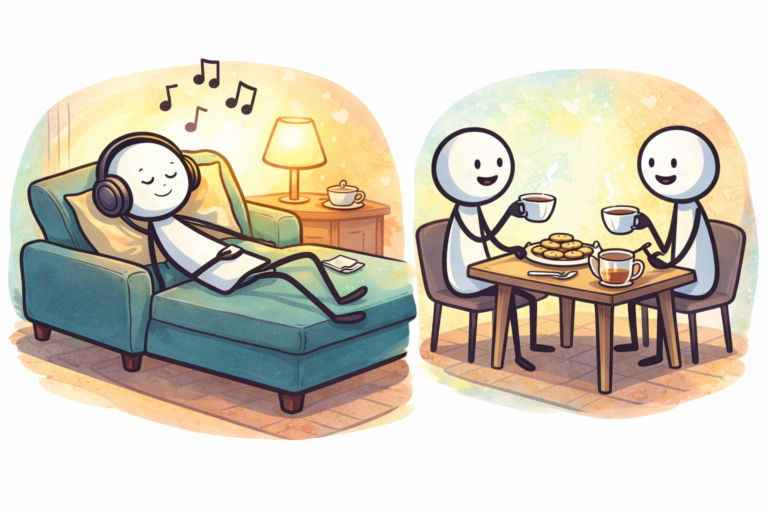
Music can calm you, wreck you, motivate you, or make you cry over someone you dated briefly during the Obama administration. A sudden noise can spike your heart rate before your brain has time to say, Relax, this is fine. A calm voice can pull someone out of panic faster than logic ever could¹².
Wow, I couldn’t hear you. I hope you enjoy this and you’ll leave me a like, it really helps. Forward this. Leave a comment. I read them all and respond. If you haven’t already, please subscribe!
So when someone tells you that sound can heal the nervous system, regulate trauma, or treat psychiatric illness, it does not sound ridiculous. It sounds intuitive.
That intuition is doing a lot of work here³.
Sound feels powerful because it actually is. Sound directly affects the nervous system, particularly arousal, attention, breathing, and emotional state⁴⁵. Psychiatry takes that seriously. Public health takes that seriously. Horror movie directors absolutely take that seriously.
What sound does not do is target disease with surgical precision just because someone assigned it a meaningful number⁶.
Sound and light share Hertz, not purpose
Hertz measures how often something oscillates per second. That is all it measures⁷. It is a ruler, not a mechanism.
Neuroscientist Robert Sapolsky (Stanford professor, stress researcher, author of Why Zebras Don’t Get Ulcers) has repeatedly emphasized that biology is effective but messy. Nervous systems are not elegant machines. They are survival systems shaped by threat, context, and constraint⁸.
That distinction matters.
Sound and light may share units, but they interact with the body in fundamentally different ways⁹¹⁰.
- Bodily systems directly tuned by Hertz alone: 0
- Wellness claims confusing measurement with mechanism: common
- Probability your nervous system is waiting for the right frequency: low
Sound is mechanical. It physically moves you.
Sound is vibration traveling through air, walls, and tissue¹¹. It does not politely arrive. It shakes. That vibration reaches the brainstem before conscious interpretation. The brainstem decides safety before opinion, which is why tone matters more than content under stress¹²¹³.
- Average brainstem response to sudden sound: about 10 milliseconds
- Time to conscious interpretation: longer
- Panic attacks resolved by logic alone: rare
As George Carlin (comedian and social critic) observed, “Think of how stupid the average person is, and realize half of them are stupider than that.”
Your brainstem is not interested in nuance.
Sound regulates state, not disease
Sound can slow breathing, alter heart rate variability, shift attention, and change arousal almost immediately¹⁴¹⁵. That makes it useful during panic, dissociation, agitation, and overload. Psychiatry uses this constantly, through music, voice, rhythm, and environmental sound control¹⁶. But regulation is not treatment.
- Time for sound to affect nervous system state: seconds
- Time for most psychiatric treatments to alter disease course: weeks to months
- Disorders cured by relaxation alone: 0
Sound helps people cope. It does not repair pathology.

Why sound therapy gets exaggerated
Sound effects are immediate and emotionally convincing. Feeling something gets mistaken for something specific happening. Sometimes something did happen. Often it was nonspecific nervous system modulation plus expectation¹⁷.
Psychologist Irving Kirsch (placebo researcher) has shown that expectation is not a side effect. It is an active ingredient¹⁸.
This does not make sound fake. It makes sound nonspecific.
- Controlled sound therapy trials: limited
- Duration of reported benefit: short term
- Confusion between symptom relief and treatment: common
As Maria Bamford (comedian who speaks openly about anxiety and mental illness) once said, “My brain is like a bad neighborhood. I try not to go there alone.”
Sound can escort you out temporarily. It does not rebuild the neighborhood.
Sound is also a public health issue
Sound affects cities, schools, workplaces, sleep, and cardiovascular risk¹⁹²⁰. Chronic noise exposure is associated with anxiety, sleep disruption, irritability, and increased cardiovascular morbidity²¹. This is why noise ordinances exist and why “you get used to it” is not reassuring.
- Urban nighttime noise exceeding WHO limits: common
- Health costs of chronic noise exposure: measurable
- People unaffected by constant noise: fewer than claimed
Sound can soothe or stress. Public health has to manage both.
Sound versus light, briefly
Sound changes how you feel now.
Light changes how your body behaves later²²²³.
Sound regulates state.
Light regulates rhythm.
They are not interchangeable, regardless of marketing language.
- Time scale of sound effects: immediate
- Time scale of light effects: gradual
- Wellness products ignoring this distinction: plentiful
We will talk about light next.
Bottom line
Sound feels powerful because it is powerful. It can regulate, soothe, destabilize, or stress depending on context and exposure. Psychiatry respects that. Public health respects that.
What sound is not: Magical, precision medicine. A cure
- Nervous systems influenced by sound daily: millions
- Diseases cured by frequency alone: 0
- People selling it that way anyway: still too many
If you disagree, have questions, or want to push back thoughtfully, leave a comment here. I read them. Curiosity beats certainty every time.
I will leave you with this, from Richard Feynman (theoretical physicist and Nobel Prize winner):
“You can know the name of something and still not know anything about it.”
Hertz is the name. Understanding takes more work.
Notes and Sources
- LeDoux, J. E. (1996). The Emotional Brain. New York: Simon & Schuster, pp. 161–189.
- Porges, S. W. (2011). The Polyvagal Theory. New York: W. W. Norton, pp. 67–92.
- Kahneman, D. (2011). Thinking, Fast and Slow. New York: Farrar, Straus and Giroux, pp. 20–58.
- Thayer, J. F., & Lane, R. D. (2000). A model of neurovisceral integration. Biological Psychology, 74(2), 97–110.
- Koelsch, S. (2014). Brain correlates of music-evoked emotions. Nature Reviews Neuroscience, 15, 170–180.
- Ernst, E. (2018). Complementary medicine. Journal of the Royal Society of Medicine, 111(1), 1–3.
- Hall, D. E. (2019). Musical Acoustics. Boston: Cengage Learning, pp. 3–12.
- Sapolsky, R. M. (2004). Why Zebras Don’t Get Ulcers. New York: Henry Holt, pp. 3–29.
- Czeisler, C. A., et al. (1999). Stability of the human circadian pacemaker. Science, 284, 2177–2181.
- Foster, R. G., & Kreitzman, L. (2014). Circadian Rhythms. Oxford: Oxford University Press, pp. 45–78.
- Rossing, T. D. (2007). Springer Handbook of Acoustics. New York: Springer, pp. 1–24.
- LeDoux, J. E. (2000). Emotion circuits in the brain. Annual Review of Neuroscience, 23, 155–184.
- van der Kolk, B. A. (2014). The Body Keeps the Score. New York: Viking, pp. 52–78.
- Bernardi, L., et al. (2006). Cardiovascular effects of music. Circulation, 114(18), 2012–2021.
- Lehrer, P., et al. (2020). Heart rate variability biofeedback. Applied Psychophysiology and Biofeedback, 45, 109–129.
- American Psychiatric Association. (2022). Practice Guideline for the Treatment of Anxiety Disorders. Washington, DC.
- Benedetti, F. (2014). Placebo Effects. Oxford: Oxford University Press, pp. 89–121.
- Kirsch, I. (2010). The Emperor’s New Drugs. London: Bodley Head, pp. 17–39.
- World Health Organization. (2018). Environmental Noise Guidelines for the European Region. Copenhagen: WHO Regional Office for Europe.
- Basner, M., et al. (2014). Auditory and non-auditory effects of noise. The Lancet, 383(9925), 1325–1332.
- Münzel, T., et al. (2018). Environmental noise and cardiovascular risk. European Heart Journal, 39(23), 2110–2120.
- Rosenthal, N. E., et al. (1984). Seasonal affective disorder. Archives of General Psychiatry, 41(1), 72–80.
- Wirz-Justice, A., & Benedetti, F. (2020). Chronotherapeutics for Affective Disorders. Basel: Karger.