INTRODUCTION: Anxiety Is the National Mood (and the Default Setting)
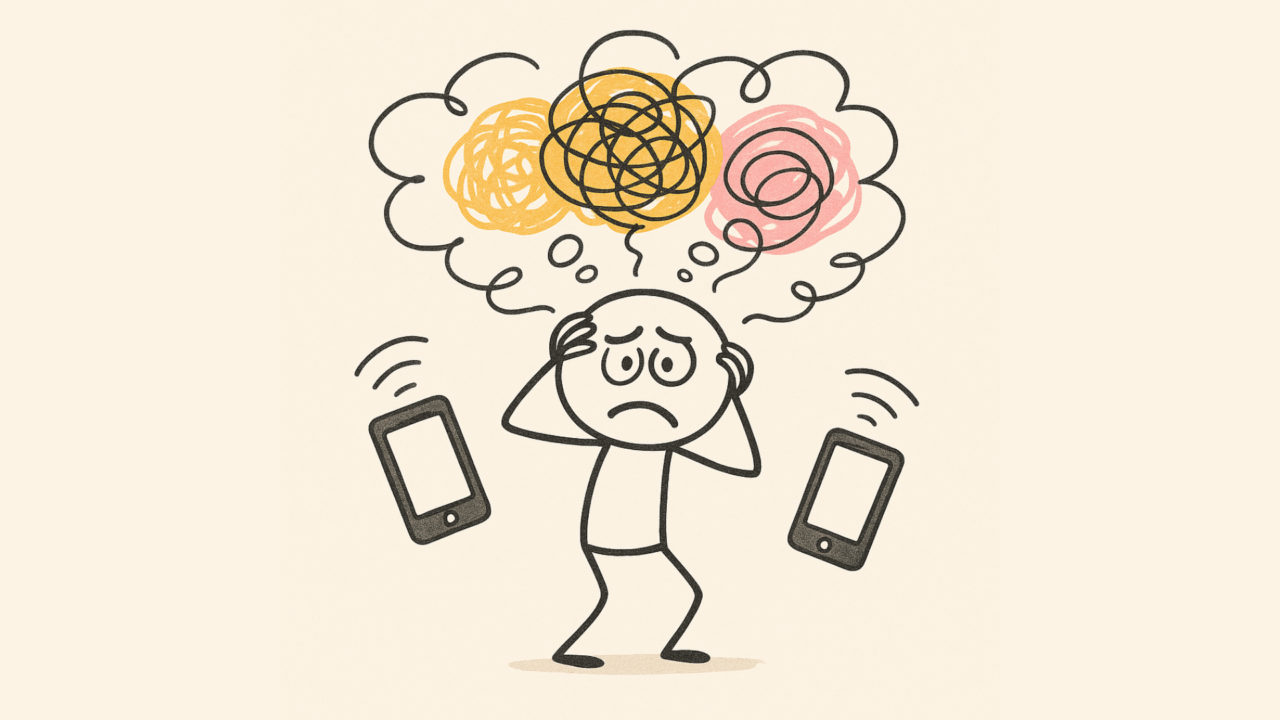
If aliens landed tomorrow and asked, “Take me to your calmest human,” we would have nothing to offer them except a barista on break who briefly forgot they had student loans.
People say things like:
- “I work well under pressure.”
- “I am just busy.”
- “I love to stay productive.”
No you do not.
Your nervous system is simply stuck in survival mode and you have mistaken the adrenaline for a personality.
As George Carlin once said,
“The caterpillar does all the work, but the butterfly gets all the publicity.”2
Your brainstem is the caterpillar.
Your Instagram bio is the butterfly.
Dr. Judson Brewer explains,
“Anxiety is fear plus uncertainty.”3
So basically everything after 2008.
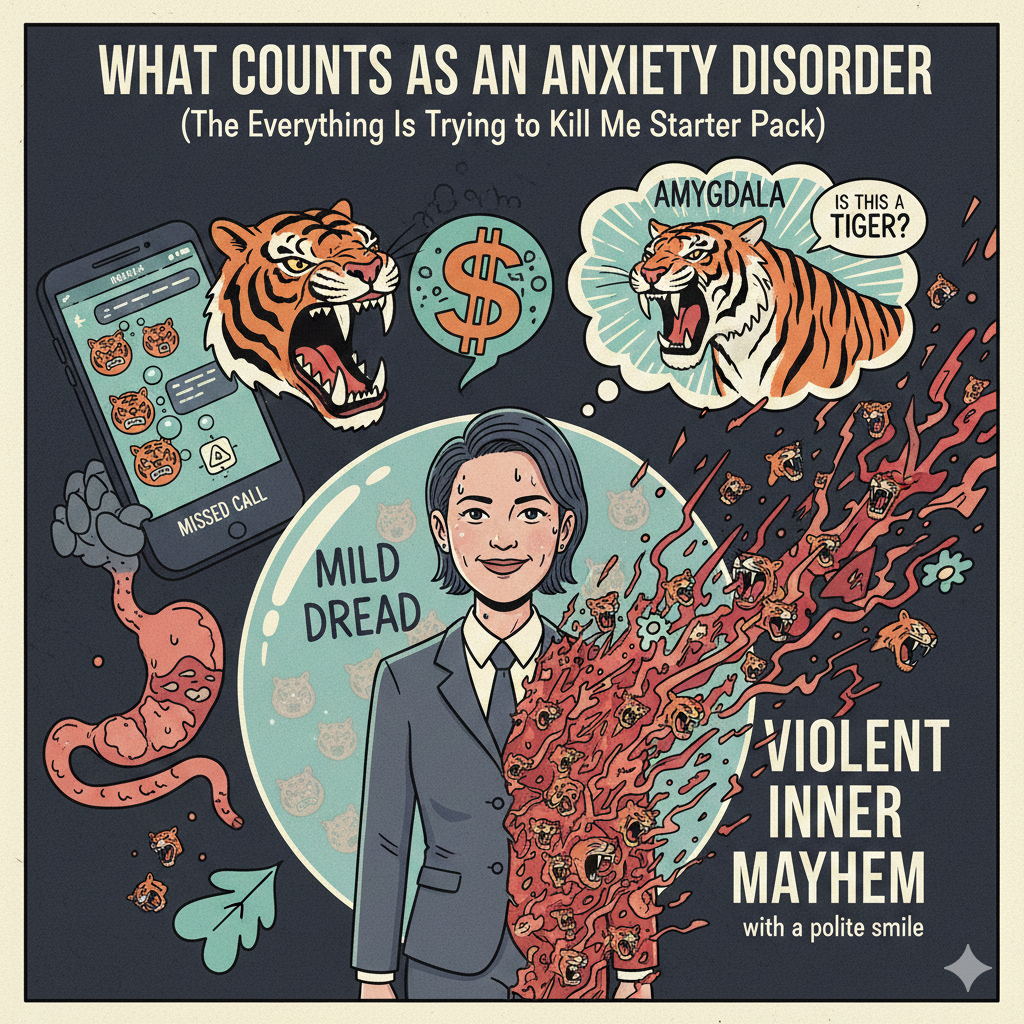
SECTION 1: WHAT COUNTS AS AN ANXIETY DISORDER (The Everything Is Trying to Kill Me Starter Pack)
Anxiety disorders are what happen when your amygdala, which evolved to detect tigers, decides that capitalism is a tiger, group chats are tigers, missed calls are tigers, and your digestive system making a noise is definitely a tiger.
You have two modes:
- Mild dread
- Violent inner mayhem with a polite smile
As Ali Wong asked,
“Why does every adult moment end in Googling what is wrong with you”4
Because our frontal lobes are shutting down like dying fluorescent lights.
Neuroscience lesson: [Image of Amygdala prefrontal cortex hijack]
Your amygdala can hijack your prefrontal cortex in about 80 milliseconds.
That is faster than your ability to say “I am fine” while clearly not fine.
Dr. Lisa Damour says,
“Anxiety is a normal and healthy function.”5
It was healthy when the threat was a predator.
Now the threat is an Outlook reminder.
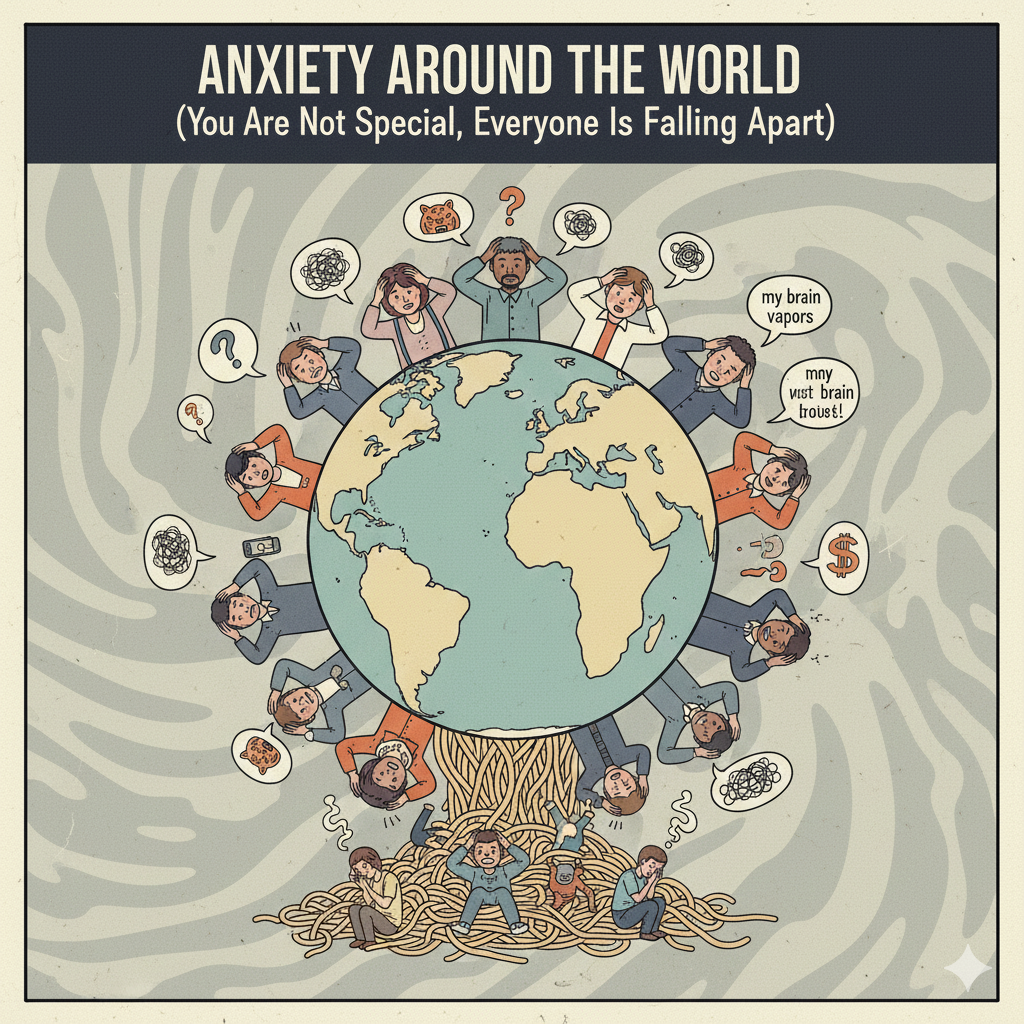
ANXIETY AROUND THE WORLD (You Are Not Special, Everyone Is Falling Apart)
Humanity is one giant overcooked noodle pretending everything is fine.
Traditional cultures called anxiety “the vapors” or “a wandering womb.”
Modern life calls it “burnout,” “overthinking,” “my therapist says I catastrophize,” and “haha, my brain is broken.”
John Mulaney summed it up perfectly,
“I will keep all my emotions right here, and then one day I will die.”6
This is the universal emotional strategy now.
Neuroscience fact:
The default mode network becomes hyperactive under chronic stress.
Translation, your brain develops a dedicated 24 hour channel for reruns of your worst thoughts.
Dr. Andrew Huberman explains,
“The brain is not designed for constant stimulation.”7
And humans said, “Interesting,” and then created push alerts.
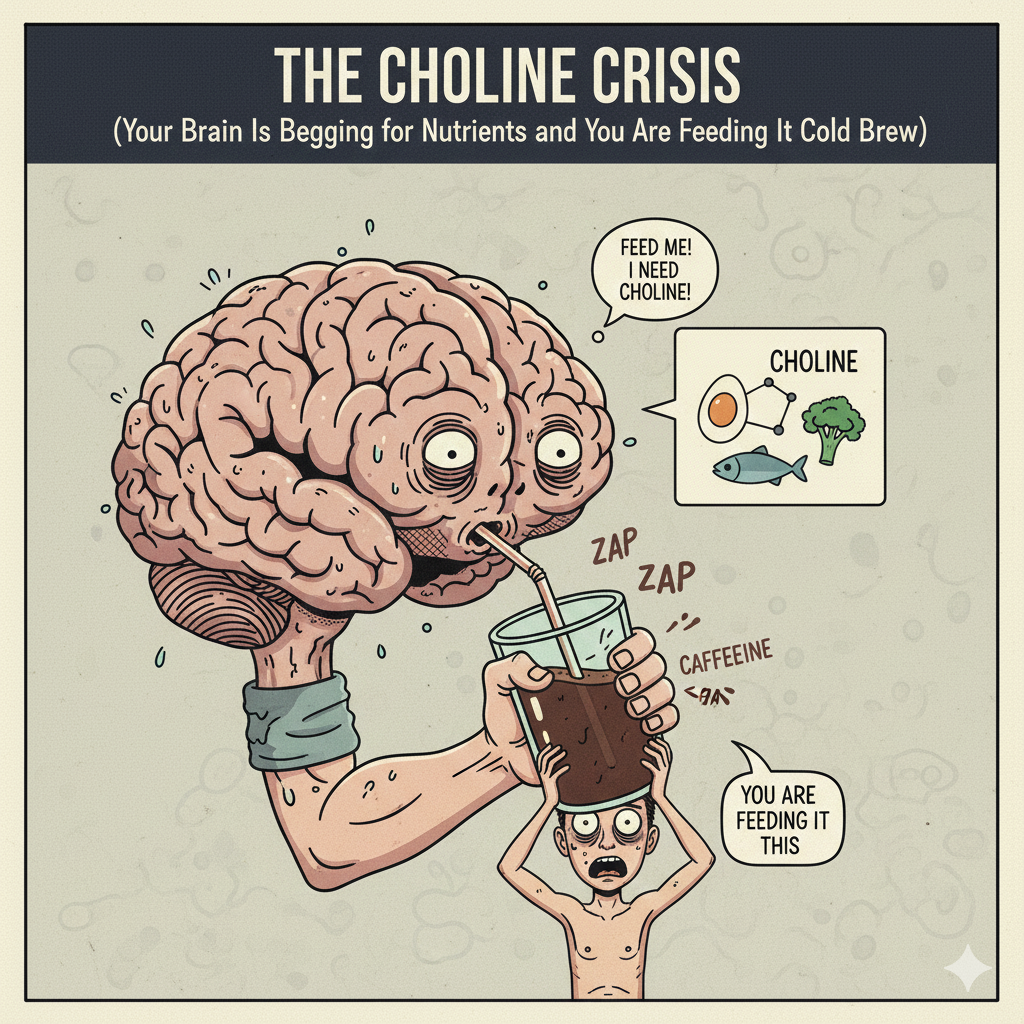
THE CHOLINE CRISIS (Your Brain Is Begging for Nutrients and You Are Feeding It Cold Brew)
Choline is essential for acetylcholine.
Acetylcholine controls attention, memory, nervous system regulation, vagal tone, focus, and your ability to not spiral when someone says “we need to talk.”
When you are low in choline, your brain behaves like:
- a malfunctioning alarm
- a squirrel that found espresso
- a toaster plugged into a lightning storm
- a car whose check engine light is permanently on
Michael Pollan advised,
“Eat food, not too much, mostly plants.”8
America said, “Cool, I will have a green juice for lunch and vibes for dinner.”
Neuroscience fact:
Low acetylcholine means the prefrontal cortex cannot regulate the amygdala, which leads to catastrophizing.
You think you are overreacting.
Your neurons are actually underperforming.
Dr. Charles Raison warns,
“When the body lacks key nutrients, the stress system becomes hyperactive.”9
Translation, your diet is turning your limbic system into a haunted house.
THE MTHFR GENE (The Biological Drama Queen That Goes, It Is Not Me, It Is You)
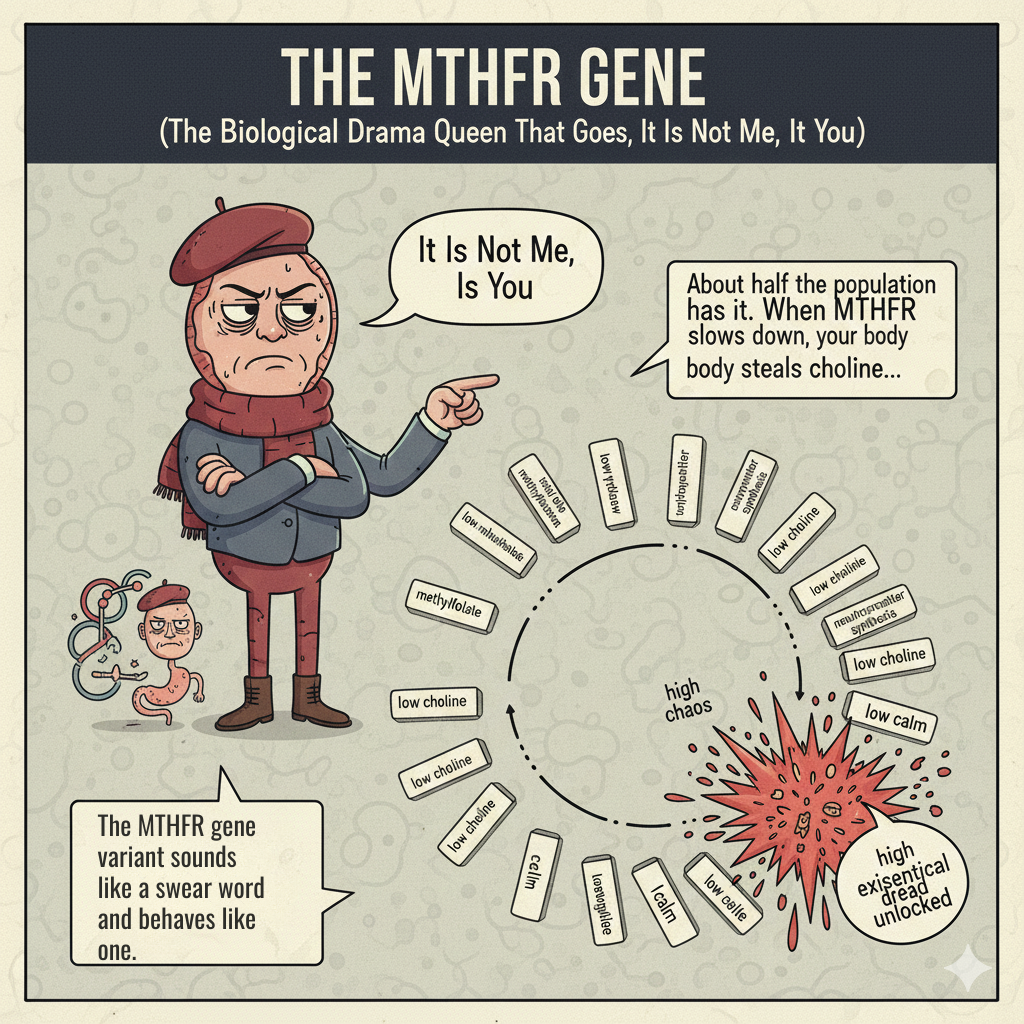
The MTHFR gene variant sounds like a swear word and behaves like one.
About half the population has it.10
It does not doom you, but it does turn your methylation cycle into a moody poet with low blood sugar.
When MTHFR slows down, your body steals choline to finish methylation tasks.
This creates a biochemical domino collapse:
- low methylfolate
- low neurotransmitter synthesis
- low choline
- low acetylcholine
- low calm
- high chaos
- existential dread unlocked
As Bill Burr once said,
“My brain is literally trying to kill me.”11
That is basically the MTHFR variant’s entire vibe.
Neuroscience detail:
Methylation regulates gene expression for serotonin receptors, dopamine transporters, GABA activity, and stress hormone receptors.
Your gene variant is not ruining your life, it is making you very, very sensitive to modern nonsense.
Dr. Ben Lynch explains,
“MTHFR does not cause disease. It increases vulnerability when the system is stressed.”12
Your gene is fragile.
Your lifestyle is an avalanche.
Congratulations.
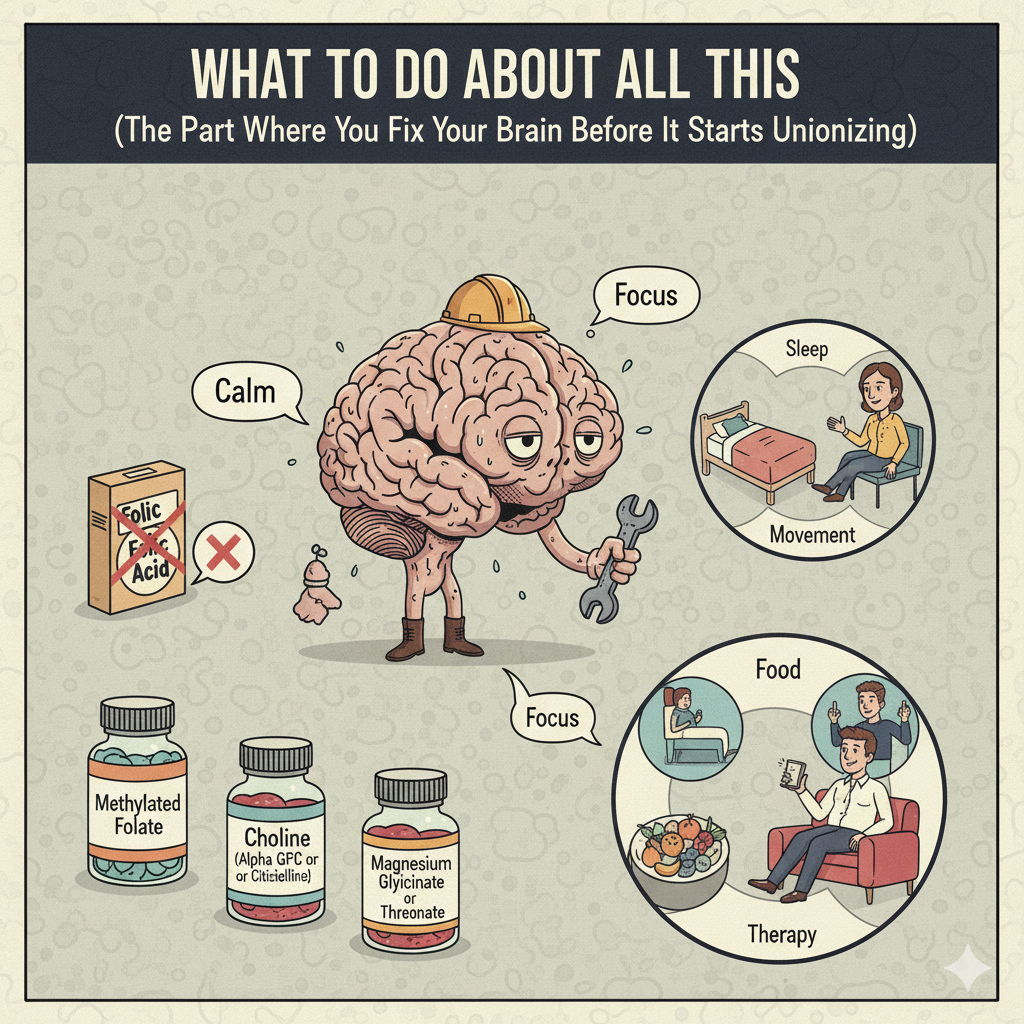
WHAT TO DO ABOUT ALL THIS (The Part Where You Fix Your Brain Before It Starts Unionizing)
Here is the non magical, non spiritual, non influencer solution.
It is biology.
It is boring.
It works.
- Methylated Folate
Bypasses the folate bottleneck and supports neurotransmitter synthesis.13
Dr. Ned Hallowell says,
“Brains run on chemistry.”14
Your chemistry is currently screaming.
- Methylated B12
Helps methylation actually function.15
Without it your neurons are like, “We quit.”
- Choline (Alpha GPC or Citicoline)
The quiet, humble nutrient that stops your brain from acting like a wounded raccoon.16
Increases acetylcholine levels so the prefrontal cortex can finally do its job.
Neuroscience bonus fact:
Acetylcholine increases signal to noise ratio in the cortex.
Which means fewer intrusive thoughts and more actual cognition.
- Magnesium Glycinate or Threonate
The mineral that tells your nervous system to sit down and breathe.17
Helps regulate NMDA receptors, sleep cycles, and cortisol rhythms.
- Reduce folic acid
Not folate.
Folic acid.
Your MTHFR variant treats it like spam mail.18
- Sleep, food, movement, therapy
The four horsemen of not becoming an emotional sinkhole.
As Jerry Seinfeld said,
“My brain is like a bad neighborhood. I do not go there alone.”19
Therapy is the flashlight.
YOU ARE NOT BROKEN (You Are Simply Biologically Chaotic in a Chaotic World)
Let us be very honest.
You are not “too sensitive.”
You are not “overreacting.”
You are not “a disaster.”
You are a human nervous system walking through a flaming dumpster of a society with prehistoric wiring, nutrient depletion, sleep debt, and a gene variant that wants to speak to the manager.
Dr. Bessel van der Kolk says,
“The body remembers what the mind forgets.”20
Your nervous system is a historian.
It files everything.
Tig Notaro sums it up:
“I am just doing the best I can with what I have got.”21
And now you have more knowledge, which technically counts as self improvement.

TALK TO ME, FEED MY EGO, OR STOP BY FOR SNACKS
I want to know what you think.
Tell me what made you laugh, what made you cringe, what made you feel seen in a way that hurt a little bit.
Leave a comment, send a message, or share the exact moment your anxiety started. I love data.
Visit me at
www.boulderpsychiatryassociates.com
And if you are in Boulder, come say hello.
I often have baked treats.
Your nervous system deserves cookies and maybe a croissant.
Footnotes
- National Institute of Mental Health. Any Anxiety Disorder Statistics. 2023. ↩
- Carlin, G. Brain Droppings. Hyperion Books, 1997. ↩
- Brewer, J. Unwinding Anxiety. Avery, 2021. ↩
- Wong, A. Dear Girls. Random House, 2019. ↩
- Damour, L. Under Pressure. Ballantine Books, 2019. ↩
- Mulaney, J. The Comeback Kid. Netflix, 2015. ↩
- Huberman, A. Stanford Neuroscience Lecture Series, 2021. ↩
- Pollan, M. In Defense of Food. Penguin Press, 2008. ↩
- Raison, C. Molecular Psychiatry, 2013. ↩
- National Library of Medicine, Genetics Home Reference, 2022. ↩
- Burr, B. Paper Tiger. Netflix, 2019. ↩
- Lynch, B. Dirty Genes. HarperOne, 2018. ↩
- Papakostas, G.I. American Journal of Psychiatry, 2012. ↩
- Hallowell, E. Delivered from Distraction. Ballantine Books, 2005. ↩
- O’Leary, F. Nutrients, 2010. ↩
- Sarter, M. Nature Reviews Neuroscience, 2016. ↩
- Kirkland, A.E. Nutrients, 2018. ↩
- Bailey, L.B. Journal of Nutrition, 2015. ↩
- Seinfeld, J. SeinLanguage. Bantam Books, 1993. ↩
- Van der Kolk, B. The Body Keeps the Score. Viking, 2014. ↩
- Notaro, T. Live. Secretly Canadian Records, 2012. ↩
- American Psychiatric Association. DSM-5-TR, 2022. ↩
- Anxiety and Depression Association of America, 2023. ↩
- Harvard School of Public Health. Choline Fact Sheet, 2020. ↩
- Institute of Medicine. Dietary Reference Intakes, 2006. ↩