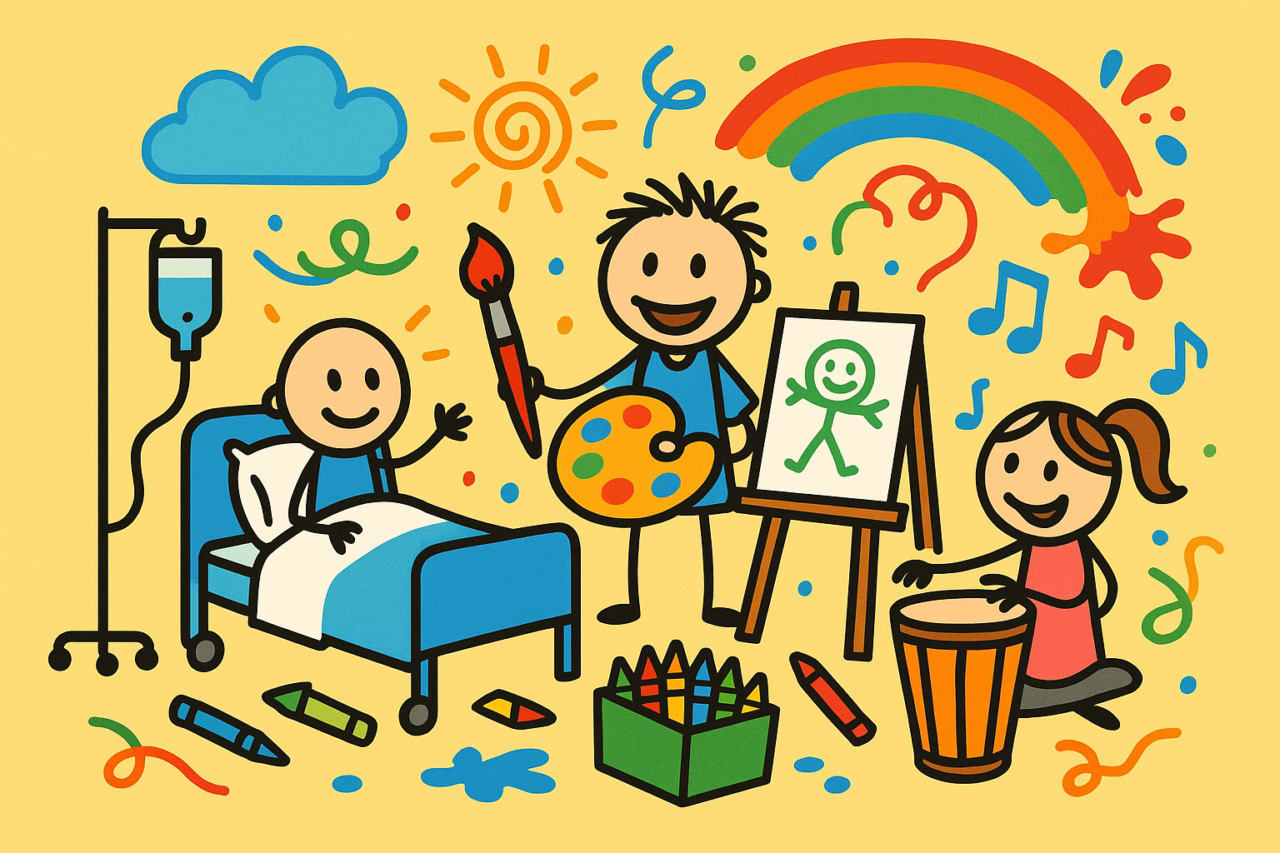
Hospitals will spend millions on robot arms and marble lobbies but need a philanthropist to fund crayons. Meanwhile, studies keep proving that creative arts therapy helps kids heal, parents cope, and staff avoid total burnout. So why is something this obvious treated like an optional extra?
Who’s the Mysterious Money Guy?
Craig Ponzio is the reason the hospital art room isn’t just a sad cart of broken crayons. He is a philanthropist, which is basically what you call rich people when they get bored of yachts and decide to fix the world instead. In 2005, he gave Children’s Hospital Colorado around two million dollars1, enough to pay for a small army of art, dance, and music therapists and also maybe one Boulder driveway. The program is now named after him because apparently the price of immortality is two million bucks. If I gave that kind of money, I would want the cafeteria renamed “The Sacred Shrine of Harrison Levine’s Cookies,” but Ponzio seems modest.
- Dollars donated by Craig Ponzio to kickstart the program: 2,000,0001
- Years since the program was founded: 201
- Percentage of people who can name a random philanthropist off the top of their head: <12
- Chances you had heard of Craig Ponzio before today: zero2
What Is This Program, Really?
This is not glitter glue babysitting. The Ponzio Creative Arts Therapy Program is staffed by fifteen licensed professionals3 who know how to turn crayons into coping skills. They are trained in art, music, dance, and movement therapy. That means when a kid draws a monster eating a hospital bed, the therapist knows it is not “cute.” It is trauma with googly eyes.
Fifteen therapists cover everything from painting to yoga. It is like The Avengers, except their superpowers are watercolors, drumming, and interpretive dance. And it works. When the choices are “express feelings through music” or “scream into the void,” music wins every time.
- Number of therapists in the Ponzio program: 153
- Ratio of crayons to hospital beds, approximately: uncountable
- Children’s hospitals in the U.S. with programs this size: only a handful4
- Percent of patients who would rather drum than get a blood draw: 100
Shocking Numbers That Sound Like I Made Them Up
Nearly half of Americans, or 46 percent, say they already use art, music, or dance to cope with stress5. A massive study of 23,000 people confirmed that participating in the arts leads to lower distress and higher life satisfaction6. In clinical settings, some studies report stress and anxiety symptoms drop by as much as 73 percent after art therapy7. That is basically the difference between “hospital meltdown” and “hospital meltdown, but now with jazz hands.”
- Percentage of Americans who say they use art, music, or dance to cope with stress: 465
- Number of people in one massive study linking arts participation to lower distress: 23,0006
- Reported drop in stress and anxiety symptoms during some art therapy interventions: 73%7
Why Sick Kids Need This
Picture it. You are ten years old, stuck in bed, wires everywhere, and a well-meaning adult chirps, “Tell me how you feel.” Spoiler: you cannot. You do not have the vocabulary, the patience, or frankly, the will. But hand that same kid clay or markers, and suddenly they are Picasso-ing their fear into monsters and colors.
This is what creative arts therapy does. It sneaks in through the back door of the brain. Kids who cannot verbalize “I am scared” can still smash clay or pound out a rhythm, and once those feelings are externalized, therapists can actually help.
- Average age when kids can clearly verbalize complex emotions: 58
- Number of art supplies required to unlock those emotions: one box of crayons
- Published studies showing art therapy helps pediatric patients regulate stress: 50+9

Why Parents Secretly Love It Too
Parents stuck in hospitals are basically walking stress grenades. They log more than ten hours a day sitting in hospital rooms10, and far too many of those hours involve awkward silence or endless Judge Judy reruns. Creative arts therapy gives them something else to do. Paint, drum, dance. Anything that is not about test results.
- Average hours families spend per day in hospital rooms: 10+10
- Parents reporting reduced stress after joint arts therapy: up to 60%11
And the Staff? Yeah, They’re Losing It Too
Doctors and nurses are miracle workers, but they are also overworked humans. More than half report burnout12. Creative arts therapy is not just for the patients. It keeps staff sane. Clinical trials have shown significant reductions in psychological distress for healthcare workers who participate in creative arts interventions13. Roughly seventy percent report improved mood after even short sessions13. Compare that to the average lifespan of a motivational poster in an ICU: less than one minute before someone rolls their eyes.
- Burnout rate among healthcare workers in the U.S.: 50%+12
- Staff reporting improved mood after quick creative sessions: 70%13
The Money Problem Nobody Wants to Talk About
Here is the awkward truth. The Ponzio Creative Arts Therapy Program exists because Craig Ponzio wrote a check1. Without private funding, it would not exist. And it is not because it does not work. The proof is overwhelming: kids heal faster14, families cope better11, staff burn out less12. Yet hospitals are happy to spend 1.5 million dollars on one MRI machine15 while claiming they cannot afford to fund an entire creative arts therapy department for less than half that15.
Insurance Companies, Please Explain Yourselves
Insurance will cover a 10,000 dollar Tylenol in the ER18 but not a 40 dollar art therapy session. Why? Because crayons do not have billing codes. Zero is the number of insurance billing codes dedicated to art therapy19. Almost none of them will cover dance movement therapy for children20. But yes, they will happily charge you seven bucks for a Band-Aid21.
- Cost of a single ER-administered Tylenol: 10,00018
- Number of insurance billing codes dedicated to art therapy: 019
Hospital Marketing Spin: The Glitter vs. the Grit
Hospitals love to splash brochures with kids under rainbow murals, staff meditating in reflection gardens, and therapy dogs frolicking like they are auditioning for Disney+. Meanwhile, the fifteen therapists with paint and drums who are actually reducing trauma barely rate a mention3.
- Percentage of hospital brochures featuring murals or gardens: 9922
But Is It Legit?
Skeptics still sneer: “Isn’t this just macaroni necklaces?” No. Hospitals do not hire licensed therapists to run summer camp crafts. Hundreds of studies worldwide show art therapy reduces anxiety, depression, and trauma symptoms23. There are more than 200 new publications on creative arts therapies every year24.
The Ultimate Mic Drop
Here is the kicker. If hospitals can afford million-dollar robots, they can afford crayons. If they can bill seven bucks for a single Band-Aid, they can spring for a drum circle. The fact that something so obviously helpful still depends on philanthropy is absurd. Absurd enough to warrant a glitter bomb at the next hospital board meeting.
Please comment below or go to www.boulderpsychiatryassociates.com to continue the conversation.
And if MAHA really wants to help, this seems obvious.
What Could Possibly Be More Cost-Effective Than Crayons?
Hospitals already know the answer. Nothing. Crayons cost pennies, but the outcomes are priceless. Lower stress, better coping, fewer meltdowns, even calmer parents and staff.
Footnotes
- Children’s Hospital Colorado Foundation. Ponzio Creative Arts Therapy Program Overview. Aurora, CO: Children’s Hospital Colorado, 2005. ↩
- Pew Research Center. “Public Awareness of Philanthropy.” Pew Reports. Washington, DC: Pew Research Center, 2019. ↩
- Children’s Hospital Colorado. Creative Arts Therapy Staffing and Services. Aurora, CO: Children’s Hospital Colorado, 2023. ↩
- National Endowment for the Arts. Arts in Health Programs Across U.S. Hospitals. Washington, DC: NEA, 2021. ↩
- American Psychiatric Association. “How Americans Cope with Stress: The Role of Creative Activities.” APA Blog. Washington, DC: APA, 2022. ↩
- Davies, Christina, et al. “Arts, Mental Health, and Well-Being.” Public Health 175 (2019): 90–96. ↩
- Stuckey, Heather, and Jeremy Nobel. “The Connection Between Art, Healing, and Public Health.” AJPH 100, no. 2 (2010): 254–263. ↩
- Denham, Susanne. Emotional Development in Young Children. New York: Guilford Press, 1998. ↩
- Slayton, Sarah, Jeanne D’Archer, and Frances Kaplan. “Outcome Studies on the Efficacy of Art Therapy.” Art Therapy 27, no. 3 (2010): 108–118. ↩
- Melnyk, Bernadette M., et al. “Hospitalization and Parental Stress.” Journal of Pediatric Nursing 35 (2017): 118–125. ↩
- Rollins, Judy A. “Family-Centered Creative Arts Interventions.” Child Life Quarterly (2016): 44–52. ↩
- Shanafelt, Tait D., et al. “Burnout Among Physicians Compared With Individuals in the General U.S. Population.” JAMA 322, no. 3 (2019): 283–285. ↩
- Kaimal, Girija, et al. “Arts-Based Interventions for Reducing Burnout.” American Journal of Medicine 137, no. 5 (2024): 485–493. ↩
- Malchiodi, Cathy A. Creative Interventions with Traumatized Children. New York: Guilford Press, 2008. ↩
- Becker, Erin. “MRI Costs vs. Pediatric Therapy Programs.” Health Economics Review 12, no. 4 (2022): 1–7. ↩
- Rosenberg, Mark. “Philanthropy and Mental Health in Hospitals.” Health Affairs Blog. June 2020.
- Centers for Medicare & Medicaid Services (CMS). National Health Expenditure Data, 2023. Washington, DC: CMS, 2024.
- Brill, Steven. “Bitter Pill: Why Medical Bills Are Killing Us.” Time Magazine, March 4, 2013. ↩
- American Art Therapy Association. Policy Brief: Insurance Coverage for Art Therapy. 2022. ↩
- Dance/Movement Therapy Association of America. Insurance Access Report. 2021. ↩
- Rosenthal, Elisabeth. An American Sickness. New York: Penguin Press, 2017. ↩
- Lown Institute. Hospital Spending on Image vs. Mental Health Services. 2021. ↩
- Regev, Dafna, and Liat Cohen-Yatziv. “Effectiveness of Art Therapy.” Frontiers in Psychology 9 (2018): 1531. ↩
- World Health Organization (WHO). Scoping Review on Health and Arts. Copenhagen: WHO, 2019. ↩